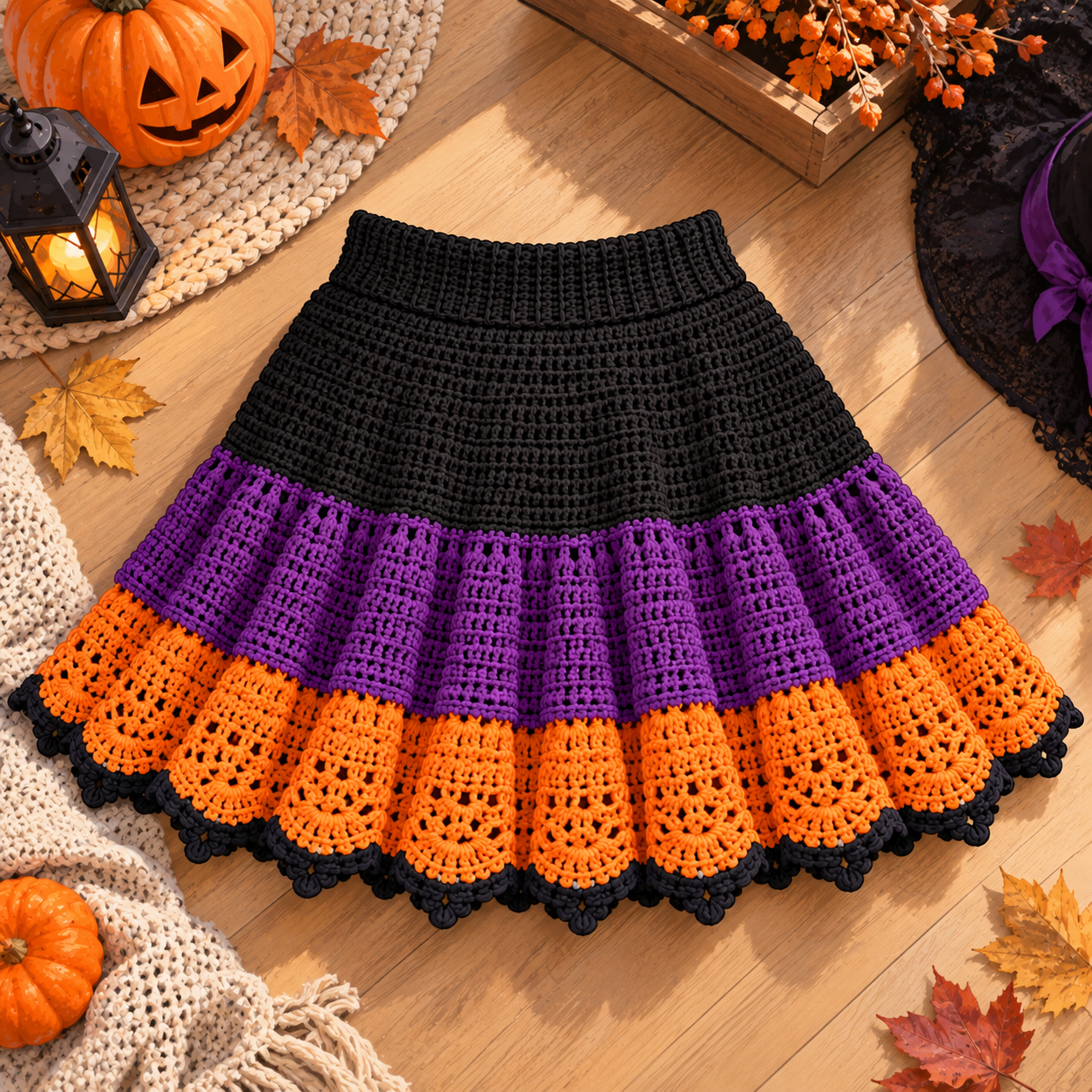
Most Halloween crochet skirt patterns give you one stitch count and wish you luck. That works if you happen to match the sample size. If you don’t, you end up ripping out a couple hundred stitches around the hips. I wanted a skirt pattern that treats fit as part of the pattern, so I built this one around a small swatch and a simple formula.
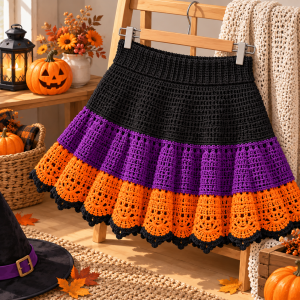
You’ll make a stretchy ribbed waistband first, then work the skirt top-down in three sections: a fitted black yoke, a full purple flounce, and an orange scalloped hem with an optional spiky black picot edge. The shapes are easy. The color blocking does most of the work of making it look like Halloween.
It’s also wearable outside October. Swap the colors and it becomes a regular tiered skirt, so it won’t sit in the back of your closet after Halloween. Notes for other palettes are at the bottom.
Finished Size
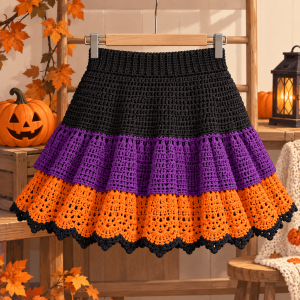
- Length: approximately 17 in / 43 cm (easy to lengthen, see below)
- Example size: waist 29 in / 74 cm, hips 40 in / 102 cm
- Waistband: about 2.5 in / 6 cm wide, with a stretchy ribbed fit
- Resizing: the formula in the Gauge section adapts it to any measurements
Skill Level
Confident Beginner. You should be comfortable with chain, slip stitch, single crochet, half double crochet, double crochet, and working in the round with increases. No lace charts, no special stitches.
Materials
Yarn (DK Weight / US 3): mercerized cotton or a cotton blend drapes best. Acrylic works if you want lighter and cheaper.
- Color A (Black): ~330 yd / 300 m — waistband, yoke, picot trim
- Color B (Purple): ~275 yd / 250 m — flounce
- Color C (Orange): ~55 yd / 50 m — scalloped hem
These are estimates. Buy an extra ball of black, since the yoke uses the most.
Hook: US G-6 / 4.0 mm (go up or down a size to hit your gauge)
Notions:
- 4 stitch markers
- Yarn needle
- Tape measure
- Optional: a slip or shorts to wear under it (crochet has gaps)
Gauge and Sizing
Please don’t skip this section. It’s what makes the skirt fit you.
Swatch: Chain 22 and work double crochet in rows for about 4 in / 10 cm. Lay it flat and count how many dc stitches fit across 10 cm. In my example that is 16 stitches = 10 cm (1.6 sts per cm). Rows come out around 1.25 cm each.
Waistband gauge: in half double crochet worked in the back loop, expect roughly 11 rows per 10 cm.
Your hip stitch count (H):
H = hip measurement in cm × stitches per cm, + about 10% for ease, rounded to a multiple of 4.
Example: 102 cm × 1.6 = 163. Add 10% and you get about 180. That’s a multiple of 4, so H = 180.
The multiple of 4 matters. The flounce increases by 1.5×, and the scallop hem needs a multiple of 6. With H = 180, the flounce has 270 stitches, which makes exactly 45 scallops.
Abbreviations (US Terms)
- ch: chain
- sl st: slip stitch
- sc: single crochet
- hdc: half double crochet
- dc: double crochet
- blo: back loop only
- inc: increase (2 sts in same stitch)
- st(s): stitch(es)
- FO: fasten off
- N: number of waistband rows (you’ll count this yourself)
- H: your hip stitch count
Skirt rounds are joined with a sl st to the top of the beginning ch-3. The ch-3 counts as your first dc.
Waistband (worked flat, then joined)
With Color A, ch 11.
- Row 1: hdc in 3rd ch from hook and in each ch across (9 hdc)
- Row 2: ch 2 (doesn’t count), turn, hdc blo in each st across (9 hdc)
- Repeat Row 2 until the strip measures about 90% of your waist, when gently stretched. For a 29 in / 74 cm waist, aim for about 26 in / 66 cm.
Fold the strip into a ring, checking it isn’t twisted. Sl st the two short ends together through both loops. Don’t cut the yarn.
Count your rows along one long edge. That number is N. In my example, N = 72.
Yoke (Black, worked top-down)
- Rnd 1: Ch 1, sc evenly along the long edge of the band, one sc in each row-end (N sts). Join. (72)
- Rnd 2: Ch 3, dc in the same st, then 2 dc in every st around. Join. (2N = 144)
- Rnds 3–4: Ch 3, dc in each st around. Join. (144)
- Rnd 5 (hip increase): You need to add H − 2N stitches, spaced evenly. In the example that’s 36 increases: ch 3, dc in next 2 sts, 2 dc in next st. Dc in next 3 sts, 2 dc in next st. Repeat from * 35 more times. Join. (180)
- Rnds 6–13: Ch 3, dc in each st around. Join. (180)
If H − 2N doesn’t divide neatly, spread the increases as evenly as you can. Small irregularities disappear into the gathers. Only the final count of H matters.
Measure with the skirt hanging, since cotton grows a bit. The yoke should be about 6¼ in / 16 cm from the waistband. Add or skip a round to hit that.
On the last slip stitch, change to Color B on the final yarn-over.
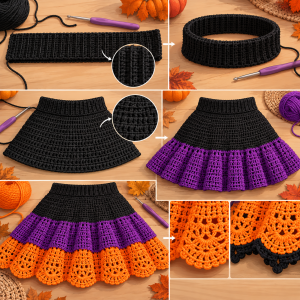
Flounce (Purple)
- Rnd 14 (flounce increase, 1.5×): Ch 3, 2 dc in next st. Dc in next st, 2 dc in next st. Repeat from * 89 more times. Join. (270)
- Rnds 15–26: Ch 3, dc in each st around. Join. (270)
Continue until the flounce measures about 6¼ in / 16 cm. Want it longer? Each extra round adds about ½ in / 1.25 cm. Add them here, because this is where length looks best. FO Color B.
Scalloped Hem (Orange)
Join Color C with a sl st in any stitch.
- Rnd 27 (shells): Ch 1, sc in same st. Skip 2 sts, 5 dc in next st, skip 2 sts, sc in next st. Repeat around, ending with skip 2 sts. Join to the first sc. (45 shells)
FO Color C.
Optional picot trim (Black): Join Color A in the center dc of any shell.
- Rnd 28: Sc in the center dc, ch 3, sl st in the first ch (picot). Sc in each of the next 2 dc, sc in the sc between shells, sc in each of the first 2 dc of the next shell. Repeat around. Join. FO.
The picots give the hem a slightly spiky, gothic edge. Skip them for a softer, prettier finish.
Finishing
- Weave in ends. Run each tail back and forth through a few stitches so nothing works loose in the wash.
- Block. Mist withwater, shape the flounce on a flat surface, and let it dry completely. Blocking evens out the stitches and makes the scallops lie flat.
- Try it on. Wear it over a slip, shorts, or leggings.
Troubleshooting
Too tight at the hips? Rip back to Rnd 5 and raise H by 8–12 stitches (keep it a multiple of 4), or go up a hook size for the yoke.
Waistband slides down? Redo the band about 5% shorter, or thread a strip of elastic through the back.
Flounce flips up? The increase round probably wasn’t evenly spaced. Place a marker every 30 stitches and count as you go.
Scallop count won’t work out? Add or drop 1–2 stitches on the last flounce round. Nobody will see it in the gathers.
Jagged color changes? Switch colors on the last yarn-over of the joining slip stitch, and carry ends up inside the next round.
A Few Ways to Switch It Up
Not into orange and purple? Try witch green with black and purple, all white for a ghost, or red and black for a vampire. The stitch counts stay exactly the same.
Want it longer? Add another purple tier before the hem. Increase 1.5× again, and make sure that stitch count is also a multiple of 6.
Want it lighter and drapier? Use sport weight cotton with a 3.5 mm hook. Redo the swatch and the formula if you do.
Want extra detail? Sew small crocheted bats or pumpkins along the flounce, or work the shell round in a metallic thread.
Care: wash on a gentle cycle or by hand in cool water and dry flat. A light steam fixes any scallops that curl.
If you make this skirt, send me a photo. Everyone’s version comes out a little different depending on yarn and colors, and I love seeing that. Drop it in the comments, or tag me if you post it. Happy hooking, and don’t let the stitch count math scare you off — it’s easier than it looks.